
The brief
The Bureau runs volunteering across Glossopdale - their own roles, and roles for other community organisations across the High Peak. That programme had outgrown the tools running it. Opportunities lived in a list someone maintained by hand. Applications arrived as emails. Nobody could answer "how many people applied this year, and what happened to them?" without counting. And every partner organisation wanting to advertise a role had to ask a member of staff to do it for them.
The charity's website is a WordPress site and it does its job well. But a volunteer programme is not a set of pages - it's records, states and people. Bolting that onto a website builder produces something nobody wants to use twice.
What we built
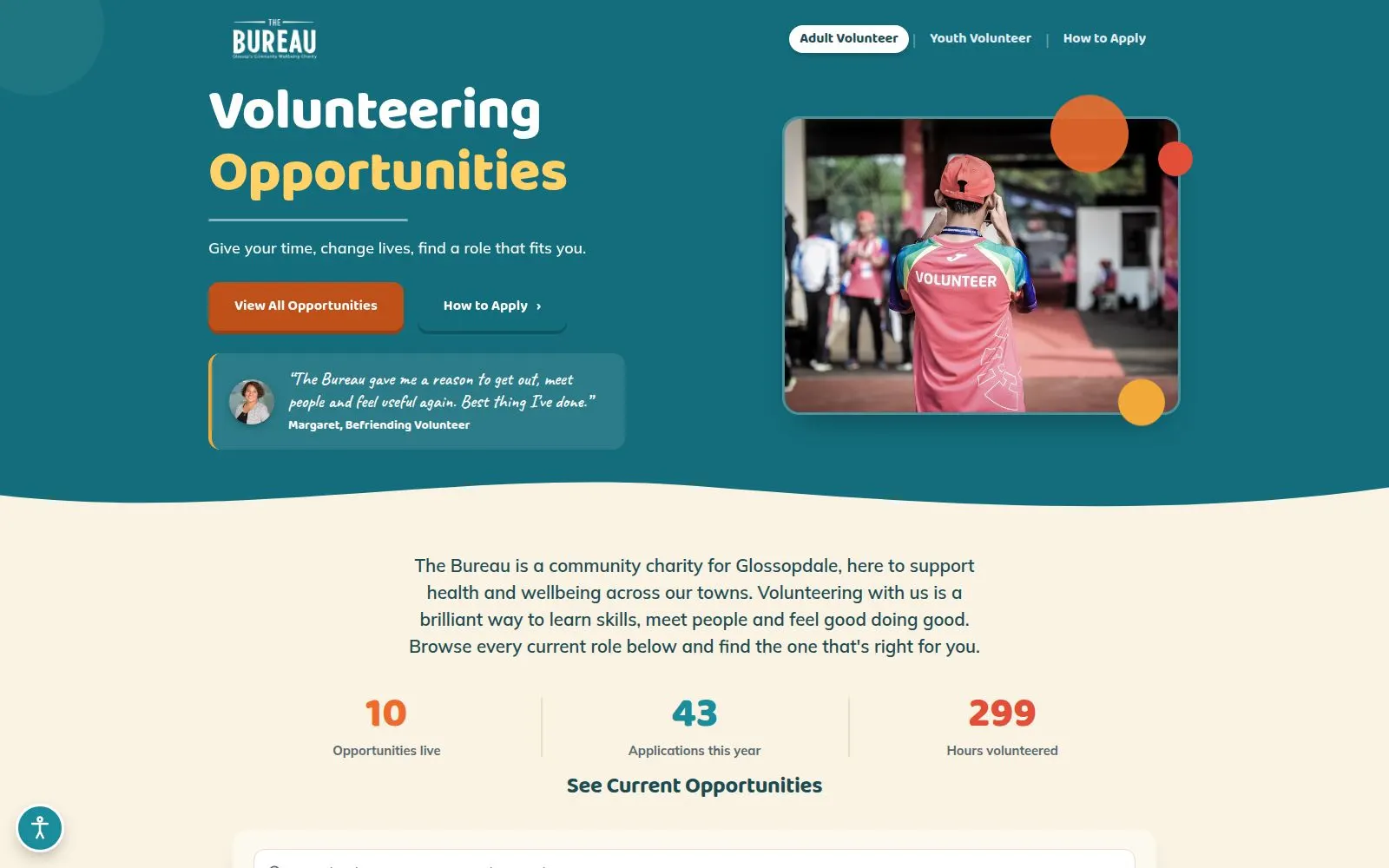
A purpose-built web application: a public opportunity listing anyone can browse and filter, a genuine apply-and-track journey for volunteers, a portal where partner organisations manage their own listings, and a staff admin that runs the whole programme. Three audiences, three views, one system - with the charity's own branding rather than a vendor's.
One public listing that filters
Every live opportunity in one place, filterable by what a volunteer actually cares about - the kind of role, where it is, how much time it takes. No PDF downloads, no "email us for a list".
An apply journey, not an email link
Applying is a proper flow: the volunteer registers once, applies to as many roles as they like, and can see where each application has got to. The charity sees the same thing from the other side.
A portal for partner organisations
Other local groups post and manage their own opportunities, scoped so they only ever see their own. The charity stops being a middleman for other people's recruitment.
A staff admin that does the whole job
Opportunities, applications, volunteers, partners, hours, onboarding checklists, tasks and messaging - eleven sections, built to be the tool the team actually runs the programme from.
Measured, not claimed
Custom software has a reputation for being slow and clunky. It doesn't have to be. These are the platform's scores in Google's own Lighthouse test - on mobile, throttled, the hard version - checked 1 August 2026:
On desktop the same page scores 98 for performance, with the main content painted in 0.9 seconds and zero total blocking time. The whole page weighs under half a megabyte. Don't take our word for it: run the platform through Google's PageSpeed test yourself - or put your own site through our free website check and see how it compares.
Honest note on the 96 for accessibility: it isn't 100, and we'd rather show you that than round up. It's a live system that keeps growing, and accessibility is checked every time it does - this one matters more than usual, because the platform is used by people the charity supports as well as by staff.
Why a charity gets custom software
Because the alternative was worse. Off-the-shelf volunteer management is priced per seat and shaped around someone else's process; a plugin on the website would have been a list with a contact form attached. What The Bureau needed - partner organisations self-serving, applications with states, hours logged against roles - is a database problem, and pretending otherwise costs a charity staff hours it doesn't have.
This is the same ladder every client of ours can climb. Most businesses need a website that brings the work in, and that's the £29.99-a-month package. When you outgrow it, the next step is built by the same people, quoted properly as a custom project - no handover to a software agency, no starting again.
Questions people ask about bespoke volunteer management systems
How much does a bespoke volunteer management system cost?
There isn't a list price, because the scope is different every time. We write the scope and agree a fixed project price before anything is built, then a monthly figure for hosting, updates, backups and support. For most organisations the honest starting point is our £29.99-a-month website; custom software is the step up when a site stops being enough.
Should a charity use off-the-shelf volunteer management software instead?
Often, yes, and we'll say so. Off-the-shelf tools are quicker to start with and cheaper if the charity is small and its process fits the vendor's. Custom made sense for The Bureau because partner organisations needed to post their own roles, applications needed states, and hours needed logging against roles - and per-seat pricing would have grown with every partner they added.
What is the volunteer management system built with, and who owns it?
Laravel 12, plain PHP and a relational database, hosted on Linux servers we run ourselves in the UK. The code sits in a repository the client can be given access to and the data is theirs, so any competent developer could take it on. That is exactly why we build on nothing exotic.
Run a charity or community group? See web design for charities, read the website case study for the same client, or tell us what you're wrestling with.